When we start working with clients, they often ask us how they can tell the difference between investment portfolios. Greenwashing is a serious concern for investors, so it’s important to understand what metrics are important.
In this article, we look at our three investment portfolios and how they differ. We compare portfolio carbon emissions and alignment to the UN Sustainable Development Goals, and we shed some light on understanding the trade-off.
Our Investment Portfolios Explained
For anyone new to the world of Paradigm Norton, you might be wondering about the letters behind our three investment portfolios. Here’s a quick guide to help you understand the differences:
- PNr: Paradigm Norton Responsible
- PNi: Paradigm Norton Intentional
- PNt: Paradigm Norton Traditional
Compare our Portfolios
Each portfolio is designed with a particular objective. The key differences are summarised below.
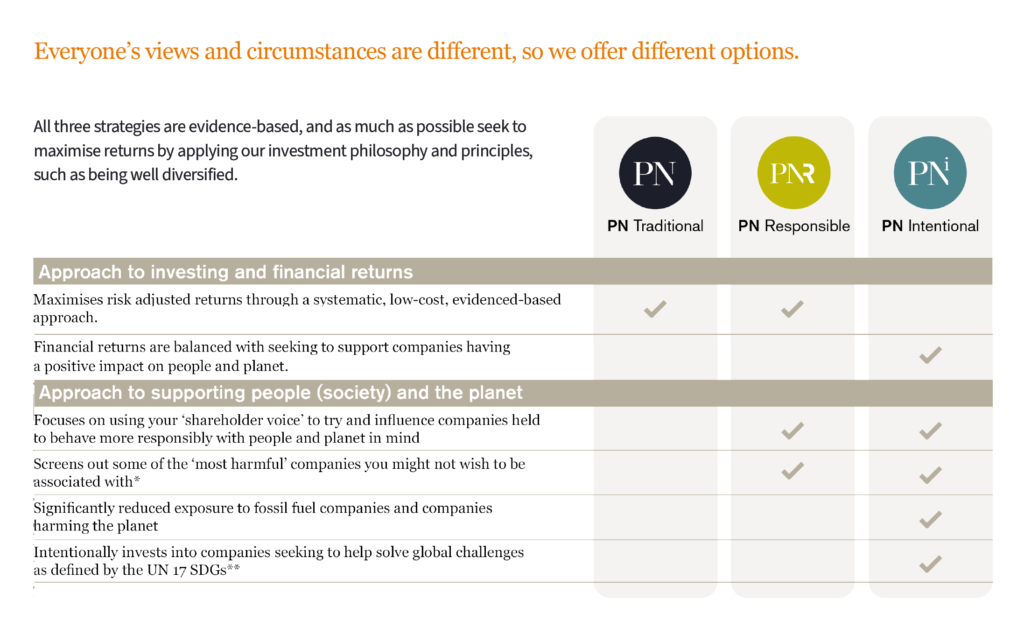
PNr: Paradigm Norton Responsible: This is our default portfolio, focused on using investors’ shareholder voice and rights to encourage companies to behave more responsibly. In practice, this means fund managers voting at company AGMs on investors’ behalf to support ESG-focused resolutions, sometimes proposing their own resolutions, or in some more extreme cases, voting against the reappointment of directors. It also means actively engaging with CEOs/chairs/boards on key issues and lobbying the Government and other bodies.
The portfolio excludes the ‘worst offenders’ that our investors would rather not be invested in, or companies that continue to refuse to engage in ESG-led conversations with fund managers. By investing in PNr, you have the potential to influence company behaviour and encourage global responsibility.
Learn more about trends in our client investing.
PNi: Paradigm Norton Intentional: For clients who want to ensure their investments support businesses with proven and legitimate sustainability credentials, measured against the UN’s Sustainable Development Goals (SDGs), we have the Paradigm Norton Intentional portfolio. This year, we revamped our PNi portfolio in partnership with Tribe Impact Capital, strengthening our ability to deliver measurable impact.
This portfolio invests in a narrower subset of companies – most of which are aligned to the SDGs – supplying products and services that humanity needs. They derive a significant amount of their revenue from products or services that are advancing solutions to one or more of the SDGs (where measurable). We’re honest with clients that, as the costs of investing in this way are higher and the portfolio is more concentrated, it is reasonable to expect that there could be a small return trade-off.
PNt: Paradigm Norton Traditional: PNt is invested in the global stock market and is a legacy portfolio for us. Some clients simply want their money to work towards keeping them financially secure and building a good retirement fund, although they may still look to achieve impact elsewhere through philanthropic activities. We have designed our Responsible portfolio to maximise risk-adjusted returns. Most of our clients have chosen to move to our responsible (PNr) option.
Comparing Portfolio Carbon Emissions and Alignment to UN Sustainable Development Goals
Two key pieces of information that clients ask about are carbon emissions and alignment with the UN’s Sustainable Development Goals. There are clear differences between the investment portfolios that we offer, and this is demonstrated in these charts:
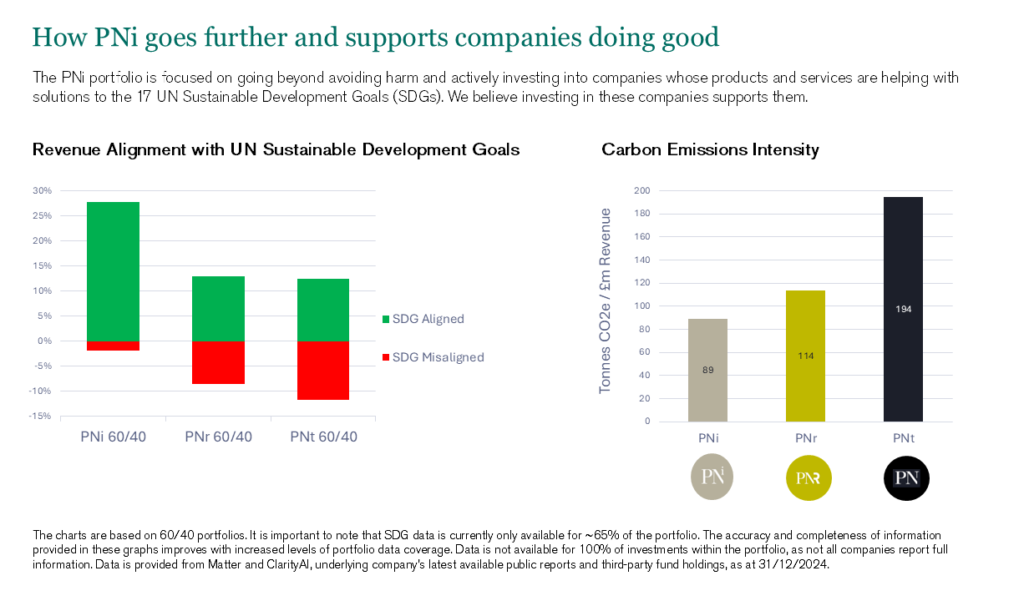
On the left, the SDG chart demonstrates the intentional nature of the PNi portfolio. The activities of the companies have a much higher alignment with the UN’s Sustainable Development Goals, as well as very little misalignment.
On the right, we can see that the carbon emissions of companies in PNr are markedly lower than PN’s traditional investment portfolio, due to screening out some of the highest emitting companies. This screening also results in PNr having a lower percentage of revenue that is misaligned with the UN SDGs.
Understanding the Trade-Offs
No portfolio is perfect. Even in PNr and PNi, some emissions and SDG misalignment occur. However, investing our PNr and PNi portfolios means you’re taking a proactive stance in holding companies to account.
Beyond carbon emissions and alignment with the UN SDGs, there are many other important factors to consider when choosing how to invest. We take time to explain this to our clients and ensure that they have as much information as they need to make a well-informed decision.
What Does This Mean for You?
Every client has unique values and financial goals. While most of our clients have chosen to move away from traditional investing, we continue to support a minority to invest in this legacy portfolio.
However, we believe that responsible investing can be pursued without necessarily compromising long-term expected returns, though returns are not guaranteed. Our focus extends beyond reducing our own company’s operational emissions to creating meaningful environmental and social impact alignment through investments. We continue to ask challenging questions and to seek to raise the bar with the expectations we have of asset managers and the global corporations that are in all of our investments.
If you’d like to discuss which portfolio aligns with your values, please get in touch.
The value of sustainable or ESG focused investments can go down as well as up, and you may not get back the amount originally invested. Past performance is not a reliable indicator of future results. Sustainable investing is an evolving area, and regulatory definitions, standards, and methodologies may change over time, potentially affecting how investments are assessed or classified. This content is for information only and does not constitute financial advice.