
Are you a business owner looking to build productivity, resilience, employee engagement and retention in a tricky financial climate? Or perhaps you’re planning your exit strategy and considering selling up?
If you’ve answered ‘yes’ to one or both of those questions, there’s another option that may not immediately spring to mind: transitioning to an employee ownership scheme, where employees become the beneficiaries of shares in the business, giving all team members a stake in its long-term success.
At Paradigm Norton, we’ve been employee-owned for seven years. Our journey has been driven by our commitment to ‘build for the future’ – one of our core values. And we’re in good company. John Lewis may be the most well-known employee-owned organisation, but other businesses like Aardman, Riverford and Richer Sounds have all adopted this model too.

As more business owners look for resilient, values‑led ways to secure their future, employee ownership is increasingly part of the conversation. In this blog, we explore employee ownership and what you need to know – from how the model works in practice to the opportunities and challenges that come with it.
What is Employee Ownership?
Fundamentally, employee ownership schemes allow employees to have beneficial ownership in the business, meaning they have a stake in its future success and can have a say in the way it’s run. Unsurprisingly, this leads to employees enjoying a far more meaningful relationship with their employer, likely resulting in more engagement, more productivity and motivating them to stay longer with the company, too. For founders, employee ownership is increasingly being seen as the primary option for exiting the business without selling.
How Does Employee Ownership Work?
Through an employee ownership model, trustees are appointed who are legally responsible for ensuring the business is run for the benefit of the new owners – the employees. The trustees provide checks and balances to the board, are consulted on all major issues and are the guardians of the culture and values of the business.
Transitioning to an employee ownership scheme can be an attractive alternative to a traditional buyout or merger. A trade sale can compromise the values of the business and lead to mass redundancies, parts of the business being ‘sold off’, and clients jumping ship.
Conversely, employee ownership schemes offer long-term continuity for both clients and the team, which can lead to better retention, productivity and job satisfaction. It’s a great way of protecting and future-proofing the business that you’ve worked so hard to build, maintaining its name, culture, legacy and values long after you’ve exited. When the time comes for existing owners to move on or retire, the business stays the same while the owners are paid out over time.
Employee Ownership is a Growing Business Trend
With over 840 members, the EOA (Employee Owned Association) says there are now around 2,470 employee-owned businesses in the UK, and this number is growing rapidly.
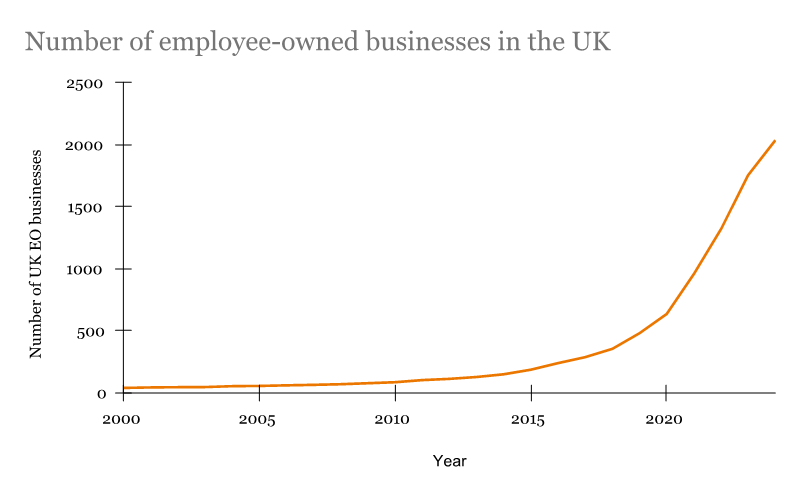
The EOA’s Annual Conference is a good place to get a sense of the growth and excitement surrounding employee ownership. In 2018 there were around 700 delegates, in 2024 this rose to around 860, with 2025’s conference seeing the same high attendance.
Another reason for its surge in popularity is that employee ownership schemes have wide cross-party governmental support. Although the 2025 Autumn Budget reduced Capital Gains Tax relief from 100% to 50%, our Head of EO, Barry Horner, sees this not as a setback, but as a potential positive for the long-term health and integrity of employee ownership.
Read: Why the Overnight EOT Tax Change Might Be a Good Thing
Why are so Many UK Businesses Embracing Employee Ownership?
It was commonly assumed that the primary driver for joining an employee ownership scheme is to take advantage of tax breaks, but we’re here to tell you that there is much more to the story than this. Yes, tax breaks are possible under this model, but it’s the many other advantages of employee ownership which are causing a sharp rise in interest from businesses across the UK.
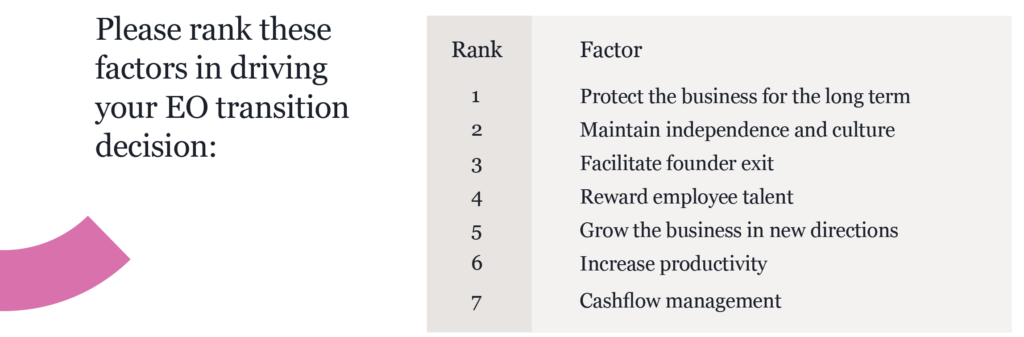
Our Co-Owner and Head of EO, Barry Horner, spoke at the 2024 EOA Annual Conference and during his session, he surveyed a group of around 80 business owners, all of whom were either considering transitioning to an employee ownership scheme, or already had. He asked attendees to rank the factors driving their EO transition decision, and the most popular motivation was to protect the business for the long term. You’ll notice that tax breaks weren’t mentioned at all!
What are the Benefits of Employee Ownership?
If tax breaks aren’t the leading benefit of employee ownership, what are the real reasons for its spike in popularity? Resilience, independence and the possibility of future profit sharing are some of the common advantages of becoming employee-owned.
Let’s explore the main benefits of employee ownership:
A Positive Shift in Company Culture – Employee ownership creates a stronger sense of shared purpose, where people feel genuinely invested in the business and empowered to contribute, collaborate and challenge for the better. 83% of those surveyed in the EOA’s People Powered Growth Report reported increased employee engagement and motivation and 73% reported increased job satisfaction.
Improved Business Performance and Long-term Stability – The EOA’s Robust Growth Champions report states that EOB’s are over 50% more likely to be what they call ‘robust growth champions’. This means they consistently deliver growth in sales, profit or headcount, while at the same time maintaining strong balance sheets. Employee-owned firms were also found to be five times less likely to make redundancies during economic challenges, demonstrating long-term stability and employee retention , according to the People Powered Growth Report.
Potential for Financial Gains for Employees – Alongside having a direct stake in the business, employees can benefit from a tax-free profit share of up to £3,600 per year, allowing them to directly share in the company’s success.
Stronger Business Performance and Productivity –EO businesses are more likely to generate profit, with non EOB’s more likely to report negative profit growth. EOB’s are also 8–12% more productive and invest more in their people, innovation and communities.
Higher Employee Engagement and Entrepreneurial Mindsets – Moving to an employee-owned model can help increases employees’ entrepreneurial mindsets. It’s not all down to the cold, hard statistics, though. Clients and employees who value your company’s culture and mission are more likely to remain loyal, with 50% of EOBs more likely to have increased investment in Research and Development (R&D) than non-EOBs.
Enhanced Reputation, Trust and Brand Loyalty – Much like having B Corp status, being employee-owned sends out a clear message to your customer base and the wider economy: you are a company that cares about its future, its people and its long-term sustainability. This reputational benefit may not be measurable, but it goes a long way towards reinforcing positive perceptions of your brand.
What are the Disadvantages of Employee Ownership?
Employee ownership schemes certainly aren’t for everyone, and at Paradigm Norton we take our clients through a detailed financial planning process to help them decide if it’s a viable option for them.
Let’s explore some of the disadvantages of becoming employee-owned:
Financial Payouts Take Time – The transition to employee ownership takes time and careful thought, and anyone looking for an immediate financial payout within a few months will be disappointed. The proceeds of sale from employee ownership are spread over a longer period, which might not feel as attractive as getting an immediate lump sum from a trade sale.
Cash Management Strain – Cash management can also create tension between current and future shareholders (especially when it comes to reinvesting in the business), as the business needs to pay out the value of the shares over time.
CGT Relief Reduction – The reduction of Capital Gains Tax relief from 100% to 50% in the 2025 Autumn Budget has shifted the landscape for founders, with most now paying an effective tax rate of around 12%. What was once a zero-tax outcome has become a tangible liability. It’s unsurprising that many feel compelled to stay involved and “protect” the business long enough to meet deferred consideration and tax obligations.
Leadership Succession Gaps – It’s worth flagging that while employee ownership will resolve ownership succession, it won’t address leadership succession. Leadership succession planning is a distinct process that should be considered separately from the transition to employee ownership to ensure business continuity.
Founder Exits and Leadership Succession
Our transition to employee ownership took a great deal of time and headspace (our inboxes were constantly filled with complex legal documents and valuations). Once we had successfully moved to the new model, only then did we begin to consider our leadership succession planning, including the recruitment of a new CEO. That meant that we could give it our full attention and go through a thorough recruitment process, so we had far more confidence in our hiring decisions.
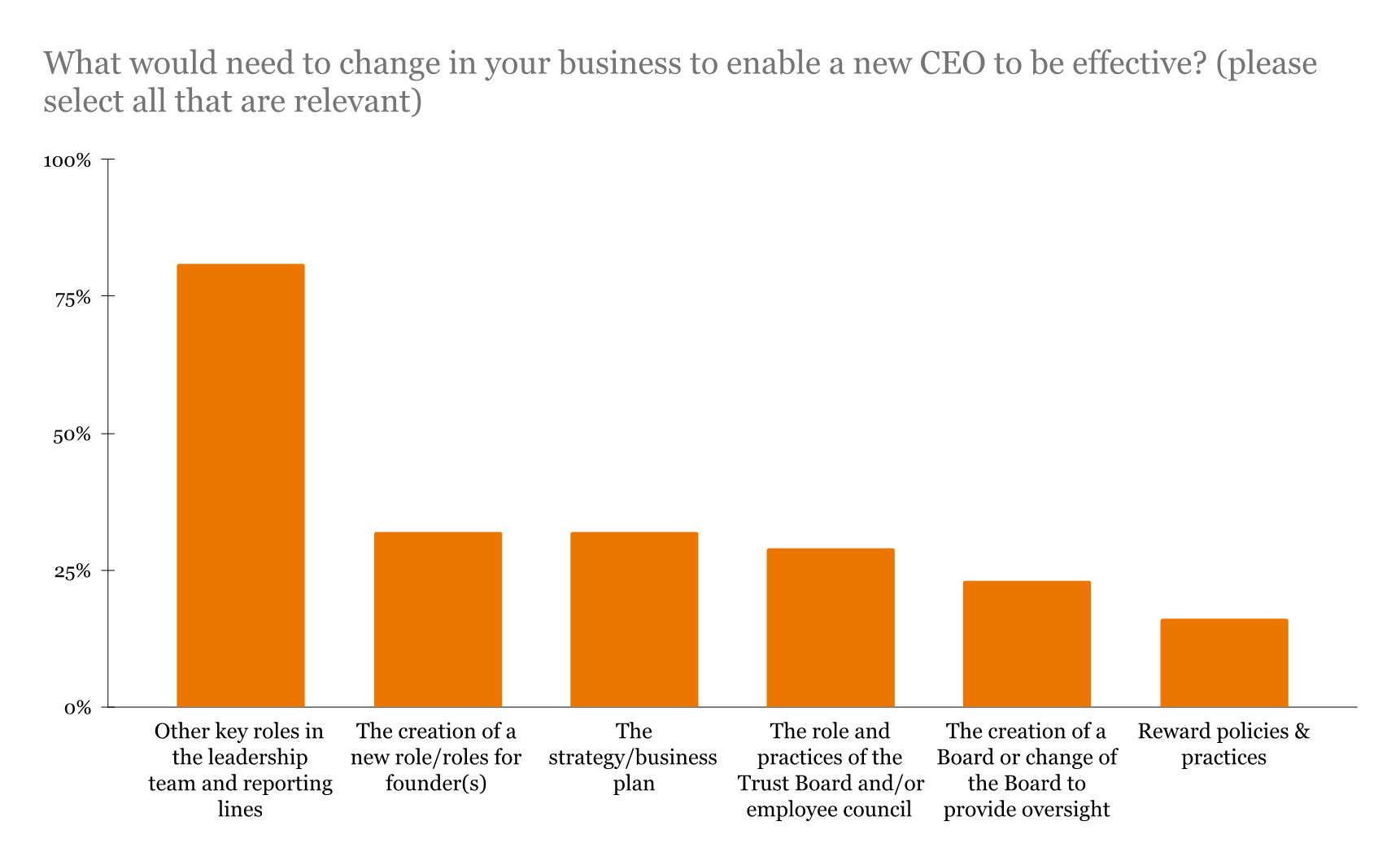
It’s important that any new leader coming into the business feels supported and able to succeed. Barry asked EOA Conference delegates what should happen to help a new CEO thrive in their role, and overwhelmingly they said that other key roles and reporting lines must be reviewed. Leadership succession planning should consider all key roles within the business, and not just those of the CEO/founder.
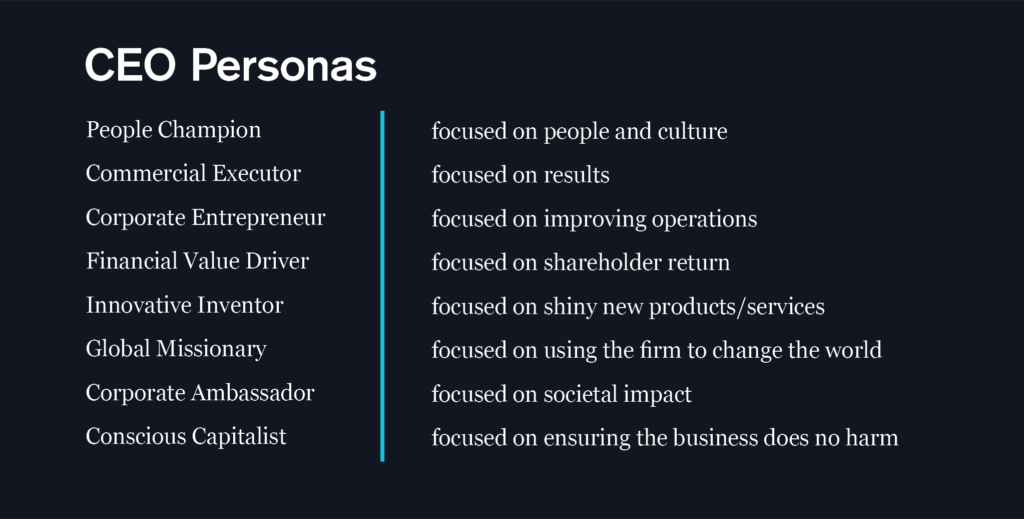
It’s crucial to find the right leader who will be able to guide the business into its future. An established business that’s growing and maturing may well need a different style of leader, so consider the attributes that your new leader/s may need (which might be very different from the ones you have now). EOA Conference delegates were asked to rank a series of CEO ‘personas’ in order of importance of what they need at their current stage of growth, and top of the list was a CEO focused on people and culture, closely followed by a leader who is focused on results.
It’s crucial to find the right leader who will be able to guide the business into its future. An established business that’s growing and maturing may well need a different style of leader, so consider the attributes that your new leader/s may need (which might be very different from the ones you have now). EOA Conference delegates were asked to rank a series of CEO ‘personas’ in order of importance of what they need at their current stage of growth, and top of the list was a CEO focused on people and culture, closely followed by a leader who is focused on results.
What Does the Future Have in Store for Employee Ownership?
Businesses are transitioning to employee ownership schemes at record rates, and this is showing no signs of slowing down. We’re anticipating that employee-owned businesses are going to be at the forefront of driving green initiatives and sustainability practices, along with robust diversity, equity and inclusion (DEI) initiatives. Alongside this, we expect that platforms for managing communications and plans around employee ownership will become more sophisticated and more widely adopted.
If an employee ownership scheme is an option that you’re exploring and you’d like some advice from financial planners who understand how it works and have been through the process themselves, then we’re here to help. Get in touch to find out more.
Reach out today to start the conversation with Barry Horner.
Learn more about our approach now.
Tax Planning is not regulated by the Financial Conduct Authority. The information contained in this article was correct at the time of publishing.